GODS OF URA NAGE
0
Ура Наге·Judoviews M.A
My favourite judokas doing Ura Nage. Khyar Walide / Lasha Shavdatuashvili / Mireia Lapuerta / Ryuju Nagayama / Beka Gvin…
Translation: хвърляне назад
Ура Наге, хвърлянето назад, е мощна жертвена техника, при която тори обвива двете си ръце около торса на уке отпред или отстрани, извива се назад и се мостира, за да повдигне и хвърли уке над собственото си тяло по висока дъга. [1],[2] За разлика от томое наге и суми гаеши, ура наге не използва крак, поставен върху тялото на противника; вместо това хвърлящата сила идва изцяло от разтягането на бедрата, извивката на гърба и дърпането с ръцете. [2],[3] Ура наге е класифицирана като ма сутеми вадза и се счита за една от физически по-натоварващите жертвени техники, изискваща значителна сила на корема и гърба. [3],[4]
Ura nage has its origins in sumo and classical jujutsu, where similar backward-arching throws were used to counter charging opponents. [1] Kodokan judo adopted ura nage into the gokyo, and the technique became a signature move of physically powerful competitors. [1],[2] In Greco-Roman wrestling, the souples (suplex) family shares biomechanical similarities with ura nage. [2],[3]
Ura nage scores high-value points in both IJF judo competition and Greco-Roman wrestling. [1]
No images yet for this technique.
Sign in to suggest an image.
My favourite judokas doing Ura Nage. Khyar Walide / Lasha Shavdatuashvili / Mireia Lapuerta / Ryuju Nagayama / Beka Gvin…
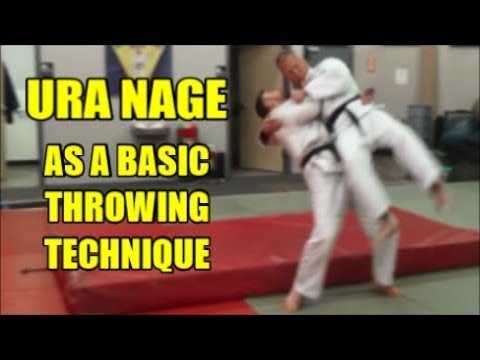
Ura Nage (Rear Throw) is a fundamentally important throwing technique and we teach it to our students at Welcome Mat ear…
No instructional courses yet for this technique.
Sign in to suggest a course.
Risk of injury to the person this technique is applied to
Ma-Sutemi-Waza; tori falls backward pulling uke over; spinal compression risk
Skill level needed to execute this technique reliably
Whether this technique is allowed under major competition rule sets
Kodokan Judo — Official Nage-waza Classification
Traditional Judo throwing technique terminology (Kodokan Institute)
Official Kodokan ground technique classification system
Standard Japanese martial arts terminology (kanji/hiragana)
Established Japanese martial arts naming convention — native Japanese term (和語/漢語)
Traditional Judo throwing technique terminology (Kodokan Institute)
hip rotation speed, core strength, lower back stability
strong hips and core, good flexibility for turning entry
hip rotators, core, quadriceps, latissimus dorsi
Ura nage (rear throw/suplex) appears in 5 passages across 3 books. The attacker lifts the opponent from the front and arches backward to slam them. One of the most dramatic throws in judo — used as a counter when the opponent drives forward aggressively. (Kano, Kodokan Judo)
According to Welcome Mat/Steve Scott, ura nage works both ways: as a counter when your opponent comes in and you drop your level to catch them, and as an aggressive movement where you rush in and catch your opponent. The core mechanics are similar, but the counter relies on timing and anticipation, while the aggressive version involves you initiating the attack.
Welcome Mat/Steve Scott emphasizes that your hips must be lower than your opponent's hips—you drop low immediately by squatting when they come in. This low hip position is critical for catching your opponent effectively and generating the throw.
Welcome Mat/Steve Scott explains that you maintain your high grip on the lapel with one hand while stepping in with the opposite side and shooting your other arm around the waist, gripping tightly. You then open, step in, slide around the waist, drop low, and use your legs to drive upward before rotating and arching back.
No—Welcome Mat/Steve Scott clarifies that while ura nage has some similar mechanics to a soup clutch, it is not the same technique. Ura nage requires more leg drive; you start low, rotate upward, then arch back and turn immediately.
Ура Наге, хвърлянето назад, е мощна жертвена техника, при която тори обвива двете си ръце около торса на уке отпред или отстрани, извива се назад и се мостира, за да повдигне и хвърли уке над собственото си тяло по висока дъга. За разлика от томое наге и суми гаеши, ура наге не използва крак, поставен върху тялото на противника; вместо това хвърлящата сила идва изцяло от разтягането на бедрата, извивката на гърба и дърпането с ръцете.
Ura nage has its origins in sumo and classical jujutsu, where similar backward-arching throws were used to counter charging opponents. Kodokan judo adopted ura nage into the gokyo, and the technique became a signature move of physically powerful competitors.
IJF: легална — Legal throwing technique; IBJJF: легална — Legal at all belt levels; UWW: легална — Legal in both freestyle and Greco-Roman; Unified MMA: легална — Legal throwing technique; ADCC: легална — Legal; FIAS Sport Sambo: легална — Legal; FIAS Combat Sambo: легална — Legal
Оценка на опасност 6/10. High — Ma-Sutemi-Waza; tori falls backward pulling uke over; spinal compression risk
Стандартната верига за подготовка: Grip Setup (Kumi-kata) → Off-Balance (Kuzushi) → Entry (Tsukuri) → Execution (Kake) → Fall (Sutemi).
Стандартните контри включват: Lower Centre of Gravity — bend knees and drop hips to make the throw harder to execute / Block the Hip — post hand on the thrower's hip to prevent loading / Step Around — circle away from the throw direction to avoid being loaded / Grip Break — deny the thrower their preferred gripping configuration.
Чести варианти: Стандартно хвърляне с бедро (пълно завъртане с бедрото под центъра на тежестта на прот…); Хвърляне с бедро без ги (адаптирано без хватове за ги, с използване на овъерхук и …); Хвърляне с бедро в падане на коляно (спускане на едно коляно за понижаване на опорната точка); Комбинирано хвърляне с бедро (свързване след неуспешна техника с крак или с ръка).
Ura nage scores high-value points in both IJF judo competition and Greco-Roman wrestling.
Основни грешки, за които да внимавате: akesal — механиката е съпоставима / Контролирай падането внимателно — ура наге може да предизвика много силни удари и наранявания на главата/шията при не… / В състезания ура наге често се появява, когато двамата се намират в клинч задънена улица.
Ура Наге е известна също като Ura Nage, Хвърляне назад, Хвърляне отзад, Ура Наге, Супплекс.