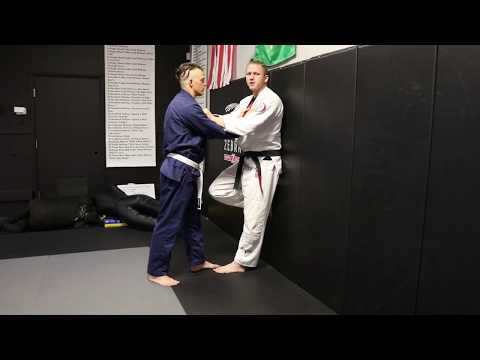
Helio Gracie Self Defense #7 Wall Pin Defense
0
Клинч с притискане към стената·Grayson Greener BJJ
Translation: клинч с притискане към стената
Wall pinning techniques developed in MMA as fighters discovered that pressing opponents against the cage was one of the most energy-efficient control methods available. [1] The tactic evolved from basic cage stalling into a sophisticated positional system with specific body positioning, weight distribution, and offensive options. [2],[3]
The wall pin clinch traps the opponent against a wall, limiting their mobility and enabling strikes and takedowns. [1]
Wall pinning developed in MMA but has analogues in traditional self-defence systems. [1]
No images yet for this technique.
Sign in to suggest an image.
No instructional courses yet for this technique.
Sign in to suggest a course.
Risk of injury to the person this technique is applied to
Cage clinch work involves grinding pressure; rib/facial abrasion risk
Skill level needed to execute this technique reliably
Whether this technique is allowed under major competition rule sets
Mastering Jujitsu (Renzo Gracie & John Danaher, 2003)
Alias sources — [1] Wrestling for Fighting (Couture, 2007) [2] MMA Instruction Manual (UFC, 2008) [3] MMA Instruction Manual (UFC, 2008)
Effectiveness sources — [1] Wrestling for Fighting (Couture, 2007)
Standard katakana transliteration of Western martial arts terminology (外来語) — used in Japanese MMA, boxing, and BJJ communities
Alias sources — [1] Wrestling for Fighting (Couture, 2007) [2] MMA Instruction Manual (UFC, 2008) [3] MMA Instruction Manual (UFC, 2008)
Effectiveness sources — [1] Wrestling for Fighting (Couture, 2007)
sustained grinding pressure, positional endurance, cage awareness
strong legs and hips for sustained cage pressure
quadriceps, glutes, shoulders, core, forearms
The wall pin uses the cage or wall to immobilize the opponent — pressing them against the surface while working for takedowns or strikes. Khabib Nurmagomedov's cage-assisted clinch and takedown system was the most dominant wall-fighting game in UFC history. (MMA competition records; The Ultimate MMA Training Guide)
Grayson Greener recommends keeping your arms inside because if your opponent winds up to punch, your hand is already positioned to defend. With arms outside, it's harder to move quickly when he winds up.
The most common mistake is trying to turn the opponent to the wall with arms extended away from your body, which creates weak mechanics. Instead, pull the opponent toward you using your back muscles—the harder they drive in, the more they'll go into the wall naturally.
Crunch your core to get your shoulder blades off the wall, then step out perpendicular to the wall while pulling your opponent toward you. Follow through with a knee strike, but control the momentum during practice.
Make sure your opponent is really pinning you realistically rather than just holding lightly, and practice all movements with increasing realism as you progress.
Семейството от позиции „клинч с притискане към стената
Wall pinning techniques developed in MMA as fighters discovered that pressing opponents against the cage was one of the most energy-efficient control methods available. The tactic evolved from basic cage stalling into a sophisticated positional system with specific body positioning, weight distribution, and offensive options.
Unified MMA: легална — Legal — clinching is integral to MMA; IJF: легална — Legal — kumi-kata (grip fighting) is fundamental to judo; IBJJF: легална — Legal — standing grip fighting and clinch work permitted; IFMA: легална — Legal — the clinch is a core element of Muay Thai, clinch dominance is highly…; WBC/Boxing: ограничена — Holding is technically a foul — referee breaks clinch, excessive holding resu…; K: ограничена — 1/GLORY — One attack from clinch allowed, then referee breaks; WAKO: ограничена — Clinch generally broken by referee — limited or no clinch fighting in most fo…; UWW: легална — Legal — clinch is fundamental to wrestling, the primary position in Greco-Roman
Оценка на опасност 4/10. Moderate — cage clinch work involves grinding pressure; rib/facial abrasion risk
Стандартната верига за подготовка: Close Distance → Establish Primary Grip → Position the Hips → Apply Pressure.
Стандартните контри включват: Pummeling — fight for inside position by swimming arms under opponent's grips / Frame and Push — create distance using forearm frames against the chest or neck / Grip Break — systematically strip the opponent's controlling grips / Posture Up — straighten the spine and drive the hips forward to break clinch control.
Чести варианти: Cage pin with underhooks (pinning the opponent against the fence with inside position); Cage pin with body lock (locking the body against the cage for control); Cage clinch with head control (using the collar tie against the fence).
Wall pin positions are used extensively in MMA to control opponents against the cage, particularly by wrestlers who use the cage as a 'third hand' for takedown setups. Khabib Nurmagomedov made the cage pin a signature control position in his UFC career.
Основни грешки, за които да внимавате: Pinning and resting — the wall pin must include active offence (strikes, takedown attempts) to score on the judges' c… / Using only upper body to pin — the hips must drive into the opponent for full control / Leaning your head into the opponent's chest (face down) — keep your head to one side for visibility / Not engaging the hips against the cage — the opponent slips sideways without hip control.
Клинч с притискане към стената е известна също като Wōru Pin Kurinchi, Притискане към клетката, Смазване към стената, Притискане към оградата.