Foundation: High Knee Shield Setup
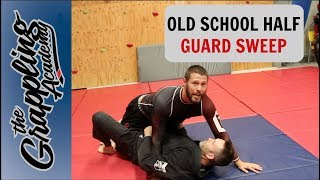
The half guard underhook sweep begins with a properly established high knee shield. This positioning allows the practitioner to curl inward and access the underhook without removing the leg from its defensive position. A high knee shield is preferable to a low shield because it creates the necessary angle for the arm to pass underneath.
Gaining the Underhook Position
Rather than competing for the underhook pummeling battle, the practitioner should sit up explosively and drive the elbow under their own leg to secure the position. This aggressive entry prevents the opponent from establishing a dominant pummeling grip. The key is to move first and establish the underhook before the opponent can counter.
Critical Underhook Height
The underhook must be positioned high on the opponent's body, reaching around the upper back rather than the waist. A low waist grip allows the opponent to easily transition cross-body and compress the underhook. By maintaining a high grip initially, the practitioner prevents this escape route and creates a secure control point.
Navigating the Corner
After securing the high underhook, the practitioner must pivot around the opponent's body by posting on the elbow or hand and scooting the hips around to the side. This corner position places the practitioner out of range of cross-body escapes. Once repositioned, the grip can transition lower to the far hip with a tight chest connection.
Establishing Chest Pressure and Hip Control
Tight chest-to-body contact is essential to prevent the opponent from creating distance or disengaging. The practitioner attaches firmly to the opponent's hips while maintaining upright posture. Any loose positioning allows the opponent to escape or mount an effective counter.
Foot Switching for Driving Power
Before standing, the practitioner must switch the trapping leg from right to left by dragging the foot to the buttocks. This foot repositioning loads the right leg to generate explosive upward drive. Without this switching motion, the practitioner lacks the mechanical advantage needed to overcome a grounded opponent's base.
The Stand and Shoulder Positioning
As the practitioner drives upward, the head must position underneath the opponent's shoulder to lift and destabilize their base. The right leg retracts sharply to block while the left leg maintains the trap. This coordinated motion combines vertical drive with rotational momentum to complete the sweep.
Finishing with Circular Drive
The final phase involves circling in front of the opponent while maintaining leg control and shoulder pressure. This rotational movement completes the sweep by taking the opponent to their back. The entire sequence—high underhook, corner pivot, chest pressure, foot switch, and circular drive—forms a cohesive technical system.
The main sweep to know from half guard (Lachlan Giles)
Key Takeaways
- •Foundation: High Knee Shield Setup
- •Gaining the Underhook Position
- •Critical Underhook Height
- •Navigating the Corner
This sweep using the underhook is the primary sweep you should look for when playing half guard, there are many follow ups you can use to create a half guard system. For more check out my courses based on half guard at https://submeta.io/@lachlangiles
Frequently Asked Questions
What does this video teach about standard old school?
This video covers foundation: high knee shield setup, gaining the underhook position, critical underhook height. It provides detailed instruction from Absolute MMA St Kilda - Melbourne.
How long does it take to learn standard old school?
The basic mechanics can be understood in a single session, but developing reliable execution requires consistent drilling over weeks of practice. This 8-part breakdown helps structure your training by isolating each phase of the technique.
What are the key details for finishing standard old school?
As the practitioner drives upward, the head must position underneath the opponent's shoulder to lift and destabilize their base. The right leg retracts sharply to block while the left leg maintains the trap. This coordinated motion combines vertical drive with rotational momentum to complete the sweep.