Front Headlock Defense Overview
This instructional covers defensive strategies against front headlock and guillotine choke attacks, ranging from early prevention to deep position escapes. The approach emphasizes simplicity while providing multiple tactical options based on the stage of the attack.
Early Prevention: Shove Off
When detecting an incoming front headlock early, the defender can simply shove the attacker away before the position becomes established. This intuitive reaction requires immediate recognition and explosive pressure to create separation.
Hip Drive Escape with Head Positioning
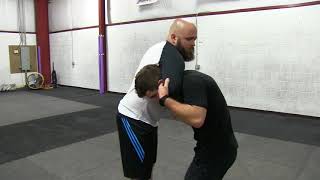
If the attacker hasn't yet clasped their hands, the defender can drive their hips forward while simultaneously turning their head up and over. This motion neutralizes the choke and allows the defender to turn the corner, access the attacker's back, or strike from the improved position.
Hip Drive Mechanics: Economy of Movement
The critical error many practitioners make is stepping wide and creating distance. Instead, the defender should run their hips into the attacker's hips while keeping movement confined, turning their head up and over in minimal space to avoid muscling through the position.
Hand Fighting: Elbow and Wrist Control
When early escape isn't possible, the defender initiates hand fighting by controlling the attacker's elbow and wrist. The defender turns their shoulder inward, takes a small step, and pops their head out while maintaining arm control, potentially establishing a two-on-one position or transitioning to strikes.
Deep Position Hand Fight: Grip Breaking
Once the attacker has completed their grip, the defender's priority is securing both hands around the attacker's arms and pulling them into their chest. The grip should be positioned as close to the fist as possible for maximum leverage, though any hand position on the arm is preferable to no defense.
Securing the Choke Before Striking
Once the choke is secured with hand control, the defender can transfer their grip down the wrist while maintaining control with the opposite hand. This stable position allows the defender to execute rising strikes and open multiple escape directions as the attacker's grip weakens.
Shutting Down Guillotine Mechanics
The guillotine succeeds through three components: forearm pressure through the throat, elbow compression on the head, and hip drive. Effective defense requires relieving forearm pressure, applying upward head pressure to lift the elbow, and maintaining hand control to prevent grip completion.
Priority: Hand Fighting Over Striking
Hand fighting must be the immediate priority before striking; if the attacker establishes solid pressure and grip control, the situation becomes critical. Only after securing hand control can the defender safely transition to strikes and positional escapes.
Training Application
Practitioners should drill early prevention through hip drives and arm pulls, progressing to hand fighting and striking scenarios from tight positions. Variations exist in wrestling, BJJ, and MMA contexts, but the fundamental priority remains controlling the attacker's hands before executing further offense.
Front Headlock Defense
Key Takeaways
- •Front Headlock Defense Overview
- •Early Prevention: Shove Off
- •Hip Drive Escape with Head Positioning
- •Hip Drive Mechanics: Economy of Movement
Taking a look at the front headlock (standing guillotine) and a few options for defending it. The goal is always to get out of the position before it fully develops, so we look at how to shut it down, as well as how to deal with it as it locks in. Enjoy! www.endeavordcf.com
Frequently Asked Questions
What does this video teach about two-on-one choke from front headlock?
This video covers front headlock defense overview, early prevention: shove off, hip drive escape with head positioning. It provides detailed instruction from Endeavor Defense & Fitness.
How long does it take to learn two-on-one choke from front headlock?
The basic mechanics can be understood in a single session, but developing reliable execution requires consistent drilling over weeks of practice. This 10-part breakdown helps structure your training by isolating each phase of the technique.
What are the key details for finishing two-on-one choke from front headlock?
Hand fighting must be the immediate priority before striking; if the attacker establishes solid pressure and grip control, the situation becomes critical. Only after securing hand control can the defender safely transition to strikes and positional escapes.
Related videos
Front Headlock Defense
Endeavor Defense & Fitness
Front Headlock Defense
Endeavor Defense & Fitness
4 Ways to Finish From Head Lock Position (Lower Belts Need to Know)
BIG OSS Jiu-Jitsu Channel
4 Ways to Finish From Head Lock Position (Lower Belts Need to Know)
BIG OSS Jiu-Jitsu Channel
Self-Defense #101 Episode 3: Front chokes
Faheem Fathah