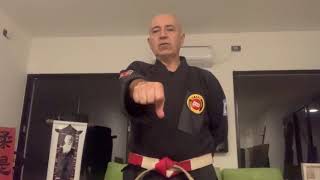
Episode Introduction
This instructional segment covers fundamental karate techniques, specifically Sanchin Dachi stance and Seiken Chudan Tsuki middle punch. The instructor demonstrates proper form and execution for practitioners developing their foundational skills.
Sanchin Dachi Stance Foundation
Sanchin Dachi is the primary defensive stance used throughout traditional karate training. The practitioner maintains a narrow, grounded stance with feet positioned hip-width apart, knees bent, and body squared forward for maximum stability and power generation.
Stance Mechanics and Weight Distribution
Proper weight distribution in Sanchin Dachi requires approximately 50% body weight on each leg, with tension maintained throughout the core and lower body. This centered positioning allows for rapid transitions and defensive responses while maintaining structural integrity.
Seiken Chudan Tsuki Introduction
The Seiken Chudan Tsuki is a straight middle punch executed from the Sanchin stance. This fundamental striking technique targets the opponent's torso and develops proper hip rotation, shoulder engagement, and fist alignment essential to karate practice.
Punch Mechanics and Hip Rotation
Power in the Seiken Chudan Tsuki originates from controlled hip rotation rather than arm extension alone. The practitioner drives force through the hips while maintaining shoulder stability, extending the striking arm straight along the body's centerline with proper fist orientation.
Hand and Fist Formation
The striking fist must be properly formed with the thumb positioned outside the fingers and wrist held rigid throughout impact. The two front knuckles (index and middle finger) deliver force, while the remaining hand acts as a guard chamber at the hip.
Integrated Stance and Punch Coordination
Combining Sanchin Dachi with Seiken Chudan Tsuki requires synchronized movement from ground to hand. The instructor demonstrates how proper stance mechanics transfer power through the kinetic chain, creating an efficient, controlled strike with maximum impact potential.
SANCHIN DACHI & SEIKEN CHUDAN TSUKI
Key Takeaways
- •Episode Introduction
- •Sanchin Dachi Stance Foundation
- •Stance Mechanics and Weight Distribution
- •Seiken Chudan Tsuki Introduction
In this video, you can see, why should we do Sanjin Dachi while you practicing Kihons. And you can see about, how to practice the correct position of Chudan Tsuki. Episode 1, https://www.youtube.com/watch?v=2nJ9fkHvFK8&t=5s Episode 2, https://www.youtube.com/watch?v=xv_bdXdMCx0&t=625s #kyokushin #kyokushinkata #kyokushinmarthandam #kyokushintamilnadu #kyokushinindia #kyokushinjapan #kyokushinkata #selfdefeasetechniques #taikyokusonosan #isometricexercise #karate #yokogeri #sidekick
Related Techniques
Frequently Asked Questions
What does this video teach about seiken chudan tsuki?
This video covers episode introduction, sanchin dachi stance foundation, stance mechanics and weight distribution. It provides detailed instruction from Kyokushin Strength (Children Dojo, Marthandam).
How long does it take to learn seiken chudan tsuki?
The basic mechanics can be understood in a single session, but developing reliable execution requires consistent drilling over weeks of practice. This 7-part breakdown helps structure your training by isolating each phase of the technique.
What are the key details for finishing seiken chudan tsuki?
The striking fist must be properly formed with the thumb positioned outside the fingers and wrist held rigid throughout impact. The two front knuckles (index and middle finger) deliver force, while the remaining hand acts as a guard chamber at the hip.