Context and Misconceptions
The instructor addresses common misconceptions about nukite, noting that many practitioners dismiss it as either requiring extreme finger conditioning or having limited practical application. He argues that nukite's utility becomes apparent when examined within the correct contextual framework, particularly when understanding the distance and timing assumptions of traditional kata.
Distance and Application Framework
Modern sport karate typically operates at longer ranges with techniques executed from distance, whereas traditional karate applications occur in close-quarter scenarios. The instructor emphasizes that nukite applications should be understood as responses to close-range attacks rather than long-distance striking scenarios, fundamentally changing how the technique is evaluated.
Shoulder and Neck Entry Application
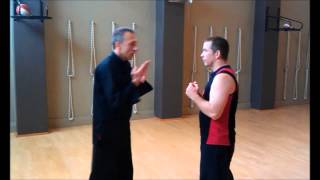
The instructor demonstrates nukite as a control technique following an arm wrap during a close-range swing attack. The hand can be placed on the shoulder or directed toward the neck and head, functioning as a bracing and control mechanism rather than requiring conditioning or striking force.
Kata Integration and Hand Positioning
Nukite appears throughout kata sequences such as Heian Nidan, where it follows shuto techniques and can be executed at various levels and angles. The technique maintains its identity whether performed downward, horizontally, or in combination with directional transitions, demonstrating versatility within established forms.
Rear Control and Cranial Pressure
In scenarios where an opponent attempts a reach or grab, nukite can be directed to maintain pressure on the back of the neck and cranium. This application, supported by kata sequences such as Kanku Dai, allows the practitioner to control an opponent's head position while managing distance and threat vectors.
Multi-Hand Combinations
Nukite often functions as part of coordinated two-hand techniques, with one hand controlling or pressing while the other executes the nukite strike. These combinations address various attack angles and allow transitions into throws, chokes, or positional control without requiring finger conditioning.
Self-Protection Context
The instructor frames nukite applications within realistic self-defense scenarios where the defender has closed distance and is operating in the clinch range. He emphasizes that these techniques reflect practical response patterns rather than sport competition or scripted drilling, making them contextually appropriate for self-protection study.
Examining Nukite
Key Takeaways
- •Context and Misconceptions
- •Distance and Application Framework
- •Shoulder and Neck Entry Application
- •Kata Integration and Hand Positioning
I put this together to address a forum post where some karateka were somewhat dismissive of nukite as an effective technique. Hopefully this helps open some eyes.
Frequently Asked Questions
What does this video teach about nukite?
This video covers context and misconceptions, distance and application framework, shoulder and neck entry application. It provides detailed instruction from Steel Mace Karate.
How long does it take to learn nukite?
The basic mechanics can be understood in a single session, but developing reliable execution requires consistent drilling over weeks of practice. This 7-part breakdown helps structure your training by isolating each phase of the technique.
What are the key details for finishing nukite?
Nukite often functions as part of coordinated two-hand techniques, with one hand controlling or pressing while the other executes the nukite strike. These combinations address various attack angles and allow transitions into throws, chokes, or positional control without requiring finger conditioning.