No-Gi Stack Positioning Fundamentals
Without a gi lapel to control, the instructor establishes the stack using a head grip instead. Proper postural alignment is critical: shoulders positioned above hips, hips above knees, with feet extended backward to generate downward pressure. This foundational structure enables all subsequent toe hold variations.
Primary Toe Hold Variations
From the stack position, the instructor demonstrates three distinct toe hold applications: the figure-four variation by crossing the foot, the underhook toe hold by hooking beneath the foot while blocking the heel, and the basic twist variation. Each variation operates on the same mechanical principle—controlling the toes while blocking the heel to create rotational pressure.
Triangle Defense and Head Control Counter
When the opponent attempts a triangle escape from the stack, maintaining sufficient height prevents the submission threat. If the opponent hooks the defender's head, the instructor redirects this into an advantage by using the head as a lever to cup and pull the heel around, converting a defensive position into offensive control.
The Waiter Carry Leg Straightening Technique
When the opponent reaches upward to defend the figure-four toe hold, the waiter carry—executed with thumb pointing inward and a hip pop—straightens the opponent's leg and prevents escape. The defender must then rotate inward to re-establish the submission angle.
Heel Hook Integration and Rudder Control
The distinction between toe holds and heel hooks blurs in practical application. From the stack position, a basic heel hook functions as a directional rudder to reposition the opponent, improving the defender's positional advantage. These lower-percentage submissions carry minimal risk while generating positional gains.
Feet as Passing Tools in Guard Retention
When the opponent resists the stack and prevents passing, the defender uses the opponent's feet as a directional rudder to manipulate body positioning. Cranking the foot forces the opponent to turn, creating space for guard passage regardless of the opponent's defensive posture.
Opportunistic MMA Applications and Humiliation Tactics
In MMA contexts where guard passage isn't the primary objective, the instructor demonstrates demoralizing control methods. These techniques utilize the same foot positioning but prioritize dominant positioning over submission completion.
Counter to Opponent Leg Lacing
When the opponent employs a toe-hook leg lace on the defender's inner thigh, the defender secures the opponent's heel and rotates, forcing the opponent to either tap or release the lace. Continued pressure creates a cascading chain of submission opportunities.
Seated Shin Lock and Calf Pressure Points
The shin lock is executed by sitting directly on the hooked leg, creating compressive pressure on the calf. Proper technique targets the thickest section of the calf where muscle meets bone, maximizing pressure efficiency and forcing submission or providing passage opportunities.
Template-Based Grappling Philosophy
Rather than prescribing rigid sequences, techniques function as templates within contextual flow. The instructor emphasizes adaptive 'if-then grappling'—when one option fails, the practitioner transitions naturally to the next available submission or positional advantage.
Toehold/Lower Body Submissions Tutorial
Key Takeaways
- •No-Gi Stack Positioning Fundamentals
- •Primary Toe Hold Variations
- •Triangle Defense and Head Control Counter
- •The Waiter Carry Leg Straightening Technique
This is a comprehensive tutorial on lower body submissions with the emphasis on the Toehold featuring Jarrod Fobes with Derrick Darling. The Toehold is one of the most effective lower body submissions used in any combat sport. "Jarrod Fobes is one of the best toehold, leglock and lower body submission technicians (and coach) in the United States. This video, a little over 7 minutes in length, offers some of the best technical advice on toeholds that I have seen." -Steve Scott
Related Techniques
Frequently Asked Questions
What does this video teach about catch wrestling toe hold?
This video covers no-gi stack positioning fundamentals, primary toe hold variations, triangle defense and head control counter. It provides detailed instruction from welcomematstevescott.
How long does it take to learn catch wrestling toe hold?
The basic mechanics can be understood in a single session, but developing reliable execution requires consistent drilling over weeks of practice. This 10-part breakdown helps structure your training by isolating each phase of the technique.
What are the key details for finishing catch wrestling toe hold?
The shin lock is executed by sitting directly on the hooked leg, creating compressive pressure on the calf. Proper technique targets the thickest section of the calf where muscle meets bone, maximizing pressure efficiency and forcing submission or providing passage opportunities.
Related videos
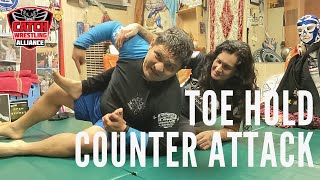
How To Counter Attack With Toe Hold
Catch Wrestling Alliance
Catch Wrestling: Karl Gotch Toe Holds: @SnakePitUSA
Snake Pit U.S.A. Original No-Gi
UDE HISHIGI HIZA GATAME, ASHI GARAMI
Patrick Bigot
Small Hand Wrap Chin Na Wrist Locking
Gary Gee
Gooseneck Wrist Lock (Nikyo): Ultimate Self-Defense Technique #aikido #hapkido #martialarts
Weapons Defense Academy