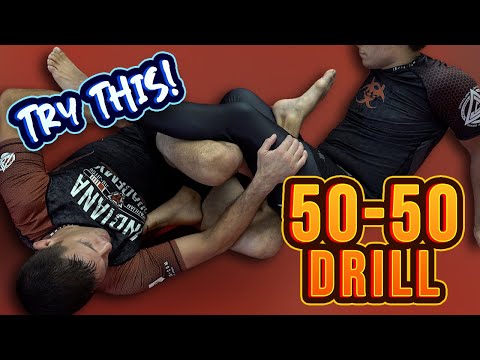
50-50 Leg Pummeling Drill
0
Leg Pummeling Defence·James Clingerman
This 50-50 Pummeling Drill will help you with positioning, attacking, and defense in the 50-50 position—giving you the a…
Translation: leg pummeling defence
The Leg Pummeling Defence subfamily covers defensive techniques where the defender systematically frees their legs from the opponent's entanglement, working to remove the legs from positions that expose them to submission attacks. [1] Leg pummelling is the ground-equivalent of hand fighting in the clinch — it involves using the legs to swim inside and outside the opponent's leg control, clearing hooks and entanglements. [1],[2] Effective leg pummelling is essential for escaping saddle, 50/50, and other leg entanglement positions that are the foundation of modern leg lock attacks. [2],[3]
Leg pummelling as a defensive concept gained prominence with the rise of sophisticated leg entanglement systems in competitive grappling. [1] The systematic teaching of leg pummelling became a critical component of defensive training as leg lock positions became more prevalent in competition. [2],[3]
Leg pummeling uses circular leg movements to free trapped legs from entanglements. [1]
Leg pummeling was developed as a core leg lock defence skill. [1]
Essential in no-gi competition. [1]
No images yet for this technique.
Sign in to suggest an image.
This 50-50 Pummeling Drill will help you with positioning, attacking, and defense in the 50-50 position—giving you the a…
No instructional courses yet for this technique.
Sign in to suggest a course.
Risk of injury to the person this technique is applied to
Submission defence involves resisting joint locks/chokes; risk of injury if defence fails or is delayed
Skill level needed to execute this technique reliably
Whether this technique is allowed under major competition rule sets
Boxing (Edwin Haislet, 1940)
Alias sources — [1] Jiu-Jitsu University (Ribeiro, 2008) [2] Fundamentals of Brazilian Jiu-Jitsu (Danaher, 2012) [3] Brazilian Jiu-Jitsu: Theory and Technique (Gracie, 2001)
Effectiveness sources — [1] Mastering Jujitsu (Gracie & Danaher, 2003)
Standard katakana transliteration of Western martial arts terminology (外来語) — used in Japanese MMA, boxing, and BJJ communities
Alias sources — [1] Jiu-Jitsu University (Ribeiro, 2008) [2] Fundamentals of Brazilian Jiu-Jitsu (Danaher, 2012) [3] Brazilian Jiu-Jitsu: Theory and Technique (Gracie, 2001)
Effectiveness sources — [1] Mastering Jujitsu (Gracie & Danaher, 2003)
reaction speed, structural body mechanics, defensive awareness
quick reflexes and conditioned defensive surfaces
varies — forearms (blocking), legs (movement), core (stability)
Every move, in any martial art, shares a few universal traits. Mix and match below to pinpoint the right tool — or compare equivalents across styles.
Start in 50/50 position, pop your opponent's leg open, turn your knee down while bringing your free leg to the inside of his knee, then push it back out to re-establish 50/50—repeat this cycle continuously. James Clingerman teaches this as a foundational pummeling sequence.
Always protect your own leg during pummeling to avoid giving your opponent easy heel hook or straight ankle lock opportunities. James Clingerman emphasizes turning your heel inward and covering your foot with your other leg as key protective positions.
The 50/50 leg pummeling drill incorporates directly into reverse heel hook defense by creating continuous movement and positioning that prevents your opponent from establishing a solid lock. James Clingerman uses the drill as preparation for this specific submission defense.
The Leg Pummeling Defence subfamily covers defensive techniques where the defender systematically frees their legs from the opponent's entanglement, working to remove the legs from positions that expose them to submission attacks. Leg pummelling is the ground-equivalent of hand fighting in the clinch — it involves using the legs to swim inside and outside the opponent's leg control, clearing hooks and entanglements.
Leg pummelling as a defensive concept gained prominence with the rise of sophisticated leg entanglement systems in competitive grappling. The systematic teaching of leg pummelling became a critical component of defensive training as leg lock positions became more prevalent in competition.
Unified MMA: legal — Legal defensive technique; IBJJF: legal — Legal — defensive techniques are fundamental to grappling; IJF: legal — Legal defensive action; ADCC: legal — Legal; UWW: legal — Legal defensive technique; FIAS Sport Sambo: legal — Legal
Danger rating 3/10. Moderate — submission defence involves resisting joint locks/chokes; risk of injury if defence fails or is delayed
The standard setup chain: Anticipate the Attack → Execute Defence → Recover Stance → Counter or Disengage.
Standard counters include: Timing — attack when the defence is recovering or between movements / Feint — use deception to create openings in the defensive structure / Angle Change — attack from an unexpected angle that the defence does not cover.
Common variants: Standard defence (primary defensive technique from the most common position); Reactive defence (triggered by the opponent's attack, minimal movement for …); Proactive defence (anticipating the attack and positioning to neutralise it …); Counter defence (using the defensive movement to create an immediate count…).
Essential in no-gi competition.
Top errors to watch for: Pummelling with the legs while keeping the hips static — hip movement drives effective leg pummelling / Pummelling but not controlling the heel — the opponent may catch the heel during the pummelling exchange / Swimming the leg outside instead of inside — the goal is always inside position; pummelling outside worsens your posi… / Not using the hands to assist leg pummelling — hand control on the opponent's knees or shins aids the leg swim.
The Leg Pummeling Defence is also known as Reggu Pameringu Difensu, Leg Pummel, Ashi Garami Pummel, Leg Entanglement Defence.