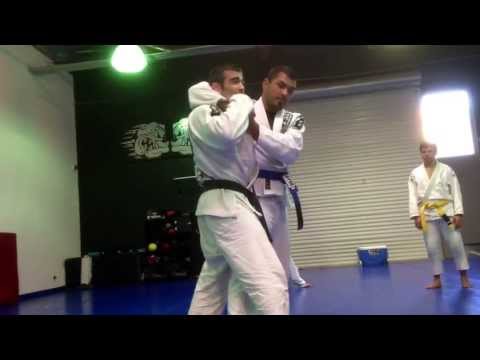
Neck crank self defense
0
Neck Crank Defence·Vladimir Trubin
via YouTube Capture
Translation: neck crank defence
The Neck Crank Defence subfamily covers defences against submissions that apply rotational or lateral bending force to the cervical spine, including can openers, neck crank variations, and face locks. [1] Neck crank defence prioritises aligning the spine and preventing the opponent from creating the angle needed to apply twisting or bending force to the neck. [1],[2] The defender works to tuck the chin, align the spine with the torso, and strip the opponent's grip before the cranking force can build to dangerous levels. [2],[3]
Neck crank defences have been taught in grappling arts since the earliest development of cervical spine submissions, with particular emphasis in catch wrestling where neck cranks are common finishing techniques. [1] Modern BJJ and MMA training includes specific neck crank defence as part of the submission defence curriculum. [2],[3]
Neck crank defence prevents lateral and rotational neck attacks. [1]
Developed in grappling. [1]
Used in grappling competition. [1]
No images yet for this technique.
Sign in to suggest an image.
via YouTube Capture
No instructional courses yet for this technique.
Sign in to suggest a course.
Risk of injury to the person this technique is applied to
Submission defence involves resisting joint locks/chokes; risk of injury if defence fails or is delayed
Skill level needed to execute this technique reliably
Whether this technique is allowed under major competition rule sets
Boxing (Edwin Haislet, 1940)
Alias sources — [1] Jiu-Jitsu University (Ribeiro, 2008) [2] Fundamentals of Brazilian Jiu-Jitsu (Danaher, 2012) [3] Brazilian Jiu-Jitsu: Theory and Technique (Gracie, 2001)
Effectiveness sources — [1] Mastering Jujitsu (Gracie & Danaher, 2003)
Standard katakana transliteration of Western martial arts terminology (外来語) — used in Japanese MMA, boxing, and BJJ communities
Alias sources — [1] Jiu-Jitsu University (Ribeiro, 2008) [2] Fundamentals of Brazilian Jiu-Jitsu (Danaher, 2012) [3] Brazilian Jiu-Jitsu: Theory and Technique (Gracie, 2001)
Effectiveness sources — [1] Mastering Jujitsu (Gracie & Danaher, 2003)
grip fighting technique, forearm endurance, timing
strong hands and forearms, quick stripping motions
forearm flexors/extensors, wrist rotators, biceps
Every move, in any martial art, shares a few universal traits. Mix and match below to pinpoint the right tool — or compare equivalents across styles.
Vladimir Trubin teaches that you should hug their far hip and hit inward—the harder they try to pull down, the harder you drive your hip in toward them to maintain your posture and prevent them from breaking you down.
Trubin emphasizes pinching the attacking arm down to your body, then stepping out to create distance and disengage from the position.
Keep your back and neck straight and drop your posture rather than letting your head get pulled forward—this protects you from the worst of the crank pressure.
By gluing their arm to your body, any movement you make will move their arm as well, giving you more control and preventing them from adjusting their grip as you step out to escape.
The Neck Crank Defence subfamily covers defences against submissions that apply rotational or lateral bending force to the cervical spine, including can openers, neck crank variations, and face locks. Neck crank defence prioritises aligning the spine and preventing the opponent from creating the angle needed to apply twisting or bending force to the neck.
Neck crank defences have been taught in grappling arts since the earliest development of cervical spine submissions, with particular emphasis in catch wrestling where neck cranks are common finishing techniques. Modern BJJ and MMA training includes specific neck crank defence as part of the submission defence curriculum.
Unified MMA: legal — Legal defensive technique; IBJJF: legal — Legal — defensive techniques are fundamental to grappling; IJF: legal — Legal defensive action; ADCC: legal — Legal; UWW: legal — Legal defensive technique; FIAS Sport Sambo: legal — Legal
Danger rating 3/10. Moderate — submission defence involves resisting joint locks/chokes; risk of injury if defence fails or is delayed
The standard setup chain: Anticipate the Attack → Execute Defence → Recover Stance → Counter or Disengage.
Standard counters include: Timing — attack when the defence is recovering or between movements / Feint — use deception to create openings in the defensive structure / Angle Change — attack from an unexpected angle that the defence does not cover.
Common variants: Standard defence (primary defensive technique from the most common position); Reactive defence (triggered by the opponent's attack, minimal movement for …); Proactive defence (anticipating the attack and positioning to neutralise it …); Counter defence (using the defensive movement to create an immediate count…).
Used in grappling competition.
Top errors to watch for: Fighting the crank by pulling the head in the opposite direction — this doubles the force on the cervical spine / Keeping the guard closed during a can opener — open the guard to relieve the cranking pressure / Not tucking the chin — an exposed neck allows full range of cranking motion / Relying on neck strength alone — technique (turning the body, framing) must accompany strength.
The Neck Crank Defence is also known as Nekku Kuranku Difensu, Can Opener Defence, Neck Lock Defence, Cervical Defence.