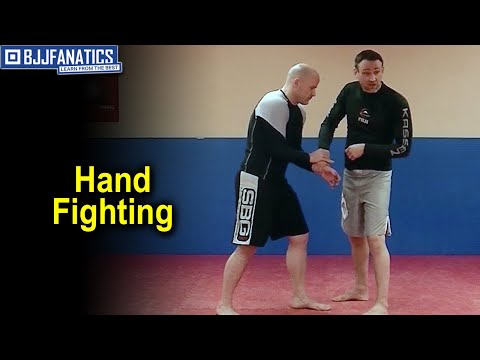
Hand Fighting by Stephen Whittier
0
Hand Fighting Defence·BJJ Fanatics
HAND FIGHTING https://bjjfanatics.com This video teaches hand fighting basics in BJJ. Stephen Whittier is one of the m…
Translation: hand fighting defence
The Hand Fighting Defence subfamily covers choke defensive techniques that focus on controlling the opponent's hands and grips to prevent them from securing the choking position. [1] Hand fighting is the most active and proactive form of choke defence — rather than passively blocking access to the neck, the defender actively fights the opponent's hands to strip grips, prevent cross-collar entries, and block the arm from threading under the chin. [1],[2] Effective hand fighting defence requires constant tactile awareness and the ability to prioritise which hand to fight based on the choke being attempted. [2],[3]
Hand fighting defence strips and controls the opponent's hands to prevent choke and submission entries. [1]
Hand fighting from bottom/defensive positions is fundamental in BJJ and MMA. [1]
Essential in MMA back control defence. [1]
No images yet for this technique.
Sign in to suggest an image.
HAND FIGHTING https://bjjfanatics.com This video teaches hand fighting basics in BJJ. Stephen Whittier is one of the m…
No instructional courses yet for this technique.
Sign in to suggest a course.
Risk of injury to the person this technique is applied to
Submission defence involves resisting joint locks/chokes; risk of injury if defence fails or is delayed
Skill level needed to execute this technique reliably
Whether this technique is allowed under major competition rule sets
Karate-Do Kyohan: The Master Text (Gichin Funakoshi, 1935)
Alias sources — [1] Jiu-Jitsu University (Ribeiro, 2008) [2] Fundamentals of Brazilian Jiu-Jitsu (Danaher, 2012) [3] Kodokan Judo (Kano, 1986)
Effectiveness sources — [1] Mastering Jujitsu (Gracie & Danaher, 2003)
Standard katakana transliteration of Western martial arts terminology (外来語) — used in Japanese MMA, boxing, and BJJ communities
Alias sources — [1] Jiu-Jitsu University (Ribeiro, 2008) [2] Fundamentals of Brazilian Jiu-Jitsu (Danaher, 2012) [3] Kodokan Judo (Kano, 1986)
Effectiveness sources — [1] Mastering Jujitsu (Gracie & Danaher, 2003)
forearm conditioning, reaction speed, structural stability
dense bone structure, strong forearms
forearm flexors/extensors, deltoids, biceps, core (absorbing impact)
Every move, in any martial art, shares a few universal traits. Mix and match below to pinpoint the right tool — or compare equivalents across styles.
According to Stephen Whittier, keep your elbows connected to the front of your body in a relaxed posture rather than creating open spaces by reaching into the body. He describes this as maintaining a 'T-Rex' position to control the line of your head and hands.
No—Stephen Whittier emphasizes that everything should be soft and relaxed; you're not trying to use a death grip to prevent your opponent from escaping the grip, since they will work against the thumb and peel away regardless.
Stephen Whittier recommends practicing a 'strip game' where you stay in close range, grab your opponent's hands, and practice peeling them off by working against the thumb, repeating this cycle to develop the habit of close-range hand fighting.
The Hand Fighting Defence subfamily covers choke defensive techniques that focus on controlling the opponent's hands and grips to prevent them from securing the choking position. Hand fighting is the most active and proactive form of choke defence — rather than passively blocking access to the neck, the defender actively fights the opponent's hands to strip grips, prevent cross-collar entries, and block the arm from threading under the chin.
Hand fighting as choke defence has been central to grappling arts since the development of choking techniques. BJJ's competitive evolution elevated hand fighting to a sophisticated defensive skill, with specific hand fighting strategies developed for each choke type.
Unified MMA: legal — Legal defensive technique; IBJJF: legal — Legal — defensive techniques are fundamental to grappling; IJF: legal — Legal defensive action; ADCC: legal — Legal; UWW: legal — Legal defensive technique; FIAS Sport Sambo: legal — Legal
Danger rating 3/10. Moderate — submission defence involves resisting joint locks/chokes; risk of injury if defence fails or is delayed
The standard setup chain: Anticipate the Attack → Execute Defence → Recover Stance → Counter or Disengage.
Standard counters include: Timing — attack when the defence is recovering or between movements / Feint — use deception to create openings in the defensive structure / Angle Change — attack from an unexpected angle that the defence does not cover.
Common variants: High block (forearm raised above the head to protect against overhead…); Low block (forearm driven downward to deflect kicks or body strikes); Cross block (forearm crosses the body to protect the opposite side); Double forearm block (both forearms together for maximum coverage).
Essential in MMA back control defence.
Top errors to watch for: Fighting both hands equally — prioritize the more advanced (choking) hand; the secondary hand is less dangerous until… / Grabbing the opponent's fingers — finger grabs are illegal in most competitions and unreliable; control the wrist / Using one hand to fight a two-handed choke entry — you need both hands on defence when the choke is being set / Letting go of the wrist to reposition — maintain constant contact; any gap allows the opponent to advance.
The Hand Fighting Defence is also known as Hando Faitingu Difensu, Grip Strip, Hand Fight, Collar Grip Defence.