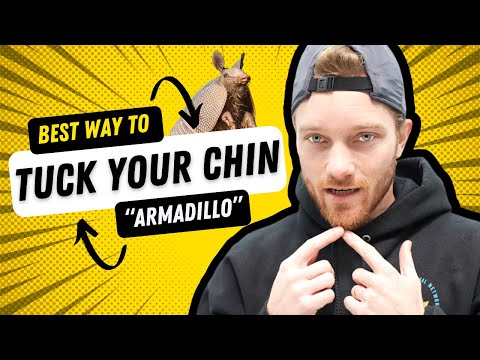
Best Way to Tuck Your Chin: Eat Punches on the Top of your Head?!
0
Standard Chin Tuck·fightTIPS·Added by Admin
Lifting your chin has got to be one of the worst habits that a fighter can have. The purpose of this demonstration is to…
Translation: standard chin tuck
The Standard Chin Tuck pulls the chin firmly to the chest while tensing the neck muscles, creating a compressed space beneath the jawline that prevents the opponent from inserting their arm or collar grip across the throat. [1] The chin is pressed downward and slightly forward, with the jaw clenched to create maximum density in the neck area. [1],[2] The standard chin tuck is combined with shoulder shrugging on the side being attacked, further closing the space around the neck. [2],[3]
The standard chin tuck is the most basic and universally taught choke defence in all grappling arts, representing the first-line defence that every practitioner learns when studying choke defence. [1] It is emphasised in BJJ, judo, and MMA as an automatic defensive reaction to back control and choking attempts. [2],[3]
The chin tuck is the most instinctive and immediate choke defence, as tucking the chin prevents the attacker from securing the choking arm or hand under the chin and directly against the throat. [1] However, experienced grapplers can finish chokes even through the chin tuck by applying sufficient pressure to compress the jaw into the carotid arteries, making the chin tuck a temporary defence that must be followed by a more complete escape. [2]
The chin tuck is taught as the first line of choke defence in virtually every grappling art, from judo to BJJ to wrestling-based MMA ground fighting. [1]
Chin tuck is the most basic choke defence in grappling. [1]
No images yet for this technique.
Sign in to suggest an image.
Lifting your chin has got to be one of the worst habits that a fighter can have. The purpose of this demonstration is to…
No instructional courses yet for this technique.
Sign in to suggest a course.
Risk of injury to the person this technique is applied to
Submission defence involves resisting joint locks/chokes; risk of injury if defence fails or is delayed
Skill level needed to execute this technique reliably
Whether this technique is allowed under major competition rule sets
Kodokan Judo (Jigoro Kano, 1986)
Alias sources — [1] Jiu-Jitsu University (Ribeiro, 2008) [2] Fundamentals of Brazilian Jiu-Jitsu (Danaher, 2012) [3] Brazilian Jiu-Jitsu: Theory and Technique (Gracie, 2001)
Effectiveness sources — [1] Jiu-Jitsu University (Ribeiro, 2008) [2] Fundamentals of Brazilian Jiu-Jitsu (Danaher, 2012)
Standard katakana transliteration of Western martial arts terminology (外来語) — used in Japanese MMA, boxing, and BJJ communities
Alias sources — [1] Jiu-Jitsu University (Ribeiro, 2008) [2] Fundamentals of Brazilian Jiu-Jitsu (Danaher, 2012) [3] Brazilian Jiu-Jitsu: Theory and Technique (Gracie, 2001)
Effectiveness sources — [1] Jiu-Jitsu University (Ribeiro, 2008) [2] Fundamentals of Brazilian Jiu-Jitsu (Danaher, 2012)
grip fighting technique, forearm endurance, timing
strong hands and forearms, quick stripping motions
forearm flexors/extensors, wrist rotators, biceps
You tend to lean away and raise your chin up to defend—which puts you at your knockout spot. The fightTIPS method uses a tennis or racquetball drill against the wall: visualize your head as a block shape and practice jutting the front corner points into the ball without leaning, keeping your eyes open and letting it come to you naturally.
You want strikes to land on naturally armored areas like the corners of your head rather than vulnerable spots like your eyes, nose, teeth, or knockout area. The skull is thick and round in these corner areas, so punches are more likely to slip off and cause less damage than if they land on unprotected zones.
Coach Adam Allahan describes a hierarchy of defense where the best case scenario is to make strikes miss completely by moving your feet, head, or body. If you can't avoid the strike, then positioning it to land on the most armored parts of your head is the next best option.
The Standard Chin Tuck pulls the chin firmly to the chest while tensing the neck muscles, creating a compressed space beneath the jawline that prevents the opponent from inserting their arm or collar grip across the throat. The chin is pressed downward and slightly forward, with the jaw clenched to create maximum density in the neck area.
The standard chin tuck is the most basic and universally taught choke defence in all grappling arts, representing the first-line defence that every practitioner learns when studying choke defence. It is emphasised in BJJ, judo, and MMA as an automatic defensive reaction to back control and choking attempts.
Unified MMA: legal — Legal defensive technique; IBJJF: legal — Legal — defensive techniques are fundamental to grappling; IJF: legal — Legal defensive action; ADCC: legal — Legal; UWW: legal — Legal defensive technique; FIAS Sport Sambo: legal — Legal
Danger rating 3/10. Moderate — submission defence involves resisting joint locks/chokes; risk of injury if defence fails or is delayed
The standard setup chain: Anticipate the Attack → Execute Defence → Recover Stance → Counter or Disengage.
Standard counters include: Timing — attack when the defence is recovering or between movements / Feint — use deception to create openings in the defensive structure / Angle Change — attack from an unexpected angle that the defence does not cover.
Common variants: Standard defence (primary defensive technique from the most common position); Reactive defence (triggered by the opponent's attack, minimal movement for …); Proactive defence (anticipating the attack and positioning to neutralise it …); Counter defence (using the defensive movement to create an immediate count…).
Chin tuck is the most basic choke defence in grappling.
Top errors to watch for: Pressing the chin down with the mouth open — clench the jaw shut; an open jaw weakens the tuck / Tucking the chin but not shrugging the shoulder — the shoulder shrug closes the gap between ear and shoulder / Holding the breath during the chin tuck — breathe through the nose; holding breath accelerates fatigue / Not immediately starting hand fighting after tucking — the tuck only buys 3-5 seconds against a skilled opponent.
The Standard Chin Tuck is also known as Sutandādo Chin Takku, Basic Chin Tuck, Standard Chin Defence, Chin-To-Chest.