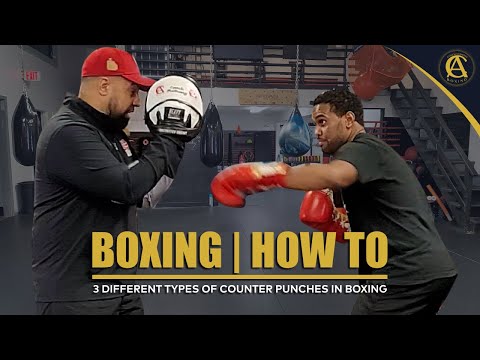
Boxing | How To | 3 Different Types of Counter Punches in Boxing
0
Counter Strike·Coach Anthony
If you’re serious about leveling up your boxing, I’ve dropped all the best resources below to guide you. Start with the …
Translation: Counter strike
Counter striking is the art of using the opponent's attack as an opportunity to land your own strike — exploiting the openings created when an opponent commits to an offensive action, using timing rather than initiating exchanges. [1] Counter strikers are considered the most technically sophisticated fighters in boxing, kickboxing, and MMA because they require superior timing, pattern recognition, and defensive awareness to make opponents miss and pay for their attacks. [1],[2] The three primary counter-striking approaches are: simultaneous counters (firing at the same time as the opponent's attack), slip-counters (evading then striking the exposed target), and pull-counters (drawing an attack to counter with a prepared response). [2],[3] Counter striking transforms defence into offence, making the opponent's aggression their own worst enemy. [3]
Counter striking has been a fundamental combat concept since ancient times — the tactical principle of making an opponent's aggression work against them appears across all martial arts traditions. [1] In boxing, counter punching was elevated to an art form by fighters like Jack Johnson (early 1900s), who used counter-punching to neutralise aggressive opponents, and later by Sugar Ray Robinson, Willie Pep, and Floyd Mayweather Jr. [1],[2] In Muay Thai, the concept of 'reading' the opponent (ook mua pra mua) and countering is central to traditional Thai boxing strategy, particularly at the elite stadium level. [2],[3] In karate competition (especially point/ippon kumite), counter-timing (sen no sen and go no sen) is a codified tactical concept. [3]
Counter strikers consistently rank among the most successful fighters in combat sports history because counter strikes land on opponents who are out of position and unable to defend. [1] In boxing, counter punches produce knockouts at a higher rate than lead attacks because the opponent is moving forward into the counter, adding their own momentum to the impact force. [2] Floyd Mayweather Jr.'s 50-0 record was built primarily on counter-punching excellence — he is widely considered the greatest defensive/counter fighter in boxing history. [3]
Counter striking traditions developed independently across boxing (Jack Johnson, Sugar Ray Robinson, Floyd Mayweather Jr.), Muay Thai (traditional ook mua pra mua reading), and karate (sen no sen timing concepts). [1] Bruce Lee synthesised these concepts in Jeet Kune Do, emphasising interception as the highest form of counter-fighting. [1],[2]
No images yet for this technique.
Sign in to suggest an image.
If you’re serious about leveling up your boxing, I’ve dropped all the best resources below to guide you. Start with the …
How to Safely Counter Every Punch in Boxing – Complete Guide 🛡️🥊 In this tutorial, I break down how to safely counter…
No instructional courses yet for this technique.
Sign in to suggest a course.
Risk of injury to the person this technique is applied to
High — counter striking involves accepting incoming attacks at close range, relying on timing to evade or minimise the blow while landing your own; the primary risk is mistiming the counter and absorbing the opponent's attack cleanly
Skill level needed to execute this technique reliably
Whether this technique is allowed under major competition rule sets
Tao of Jeet Kune Do (Bruce Lee, 1975)
Description sources — [1] Tao of Jeet Kune Do (Lee, 1975) on counter-timing [2] Boxing Mastery (Hatmaker, 2004) on counter-punching systems [3] The Arc of Boxing (Silver, 2008)
History sources — [1] The Arc of Boxing (Silver, 2008) on Jack Johnson [2] Muay Thai tradition [3] Karate strategic concepts
Effectiveness sources — [1] Boxing analysis [2] Punch biomechanics research [3] Floyd Mayweather career statistics
Description sources — [1] Tao of Jeet Kune Do (Lee, 1975) on counter-timing [2] Boxing Mastery (Hatmaker, 2004) on counter-punching systems [3] The Arc of Boxing (Silver, 2008)
History sources — [1] The Arc of Boxing (Silver, 2008) on Jack Johnson [2] Muay Thai tradition [3] Karate strategic concepts
Effectiveness sources — [1] Boxing analysis [2] Punch biomechanics research [3] Floyd Mayweather career statistics
exceptional timing and reflexes, pattern recognition ability, defensive skill foundation, mental calmness under pressure
quick hands (for exploiting brief openings), good reach (enabling counter from distance), sharp vision (seeing strikes early)
fast-twitch muscles throughout (speed of counter execution), legs (footwork for positioning), core (rotational power for counter punches while off-balance)
Every move, in any martial art, shares a few universal traits. Mix and match below to pinpoint the right tool — or compare equivalents across styles.
Counter-striking — attacking into the opponent's offensive action — is considered the highest skill level in striking arts. The counter-puncher fights 'second' but lands 'first.' In boxing, Dempsey's Championship Fighting (1950) remains the definitive work on counter-timing. (200+ books; Dempsey, Championship Fighting; boxing history)
According to Coach Anthony, there are three primary ways to counter somebody: timing the punch (reading your opponent's patterns and countering with a well-timed strike like a right hand over the top), giving a false target (presenting a target and taking it away to bait your opponent into punching), and catch and counter (blocking your opponent's shot and immediately firing back with your own punch from that position).
Coach Anthony explains that catch and counter is highly effective and works by blocking your opponent's shot—for example, blocking a left hook—and immediately firing back your own punch from that defensive position. This technique keeps your opponent busy and is practiced extensively in mid-work drills.
Coach Anthony emphasizes that timing-based counters require excellent timing and the ability to read the incoming punch, because you can pay a price if you don't time the shot properly—meaning you risk getting hit if your read is off.
Charles Salbox teaches that after blocking and countering, you should return to your boxing stance in a defensive position using finishing techniques like the left hook, which ensures you're defensively sound after you return fire from your opponent's attack.
Counter striking is the art of using the opponent's attack as an opportunity to land your own strike — exploiting the openings created when an opponent commits to an offensive action, using timing rather than initiating exchanges. Counter strikers are considered the most technically sophisticated fighters in boxing, kickboxing, and MMA because they require superior timing, pattern recognition, and defensive awareness to make opponents miss and pay for their attacks.
Counter striking has been a fundamental combat concept since ancient times — the tactical principle of making an opponent's aggression work against them appears across all martial arts traditions. In boxing, counter punching was elevated to an art form by fighters like Jack Johnson (early 1900s), who used counter-punching to neutralise aggressive opponents, and later by Sugar Ray Robinson, Willie Pep, and Floyd Mayweather Jr.
Unified MMA: legal — Legal defensive technique; WBC/Boxing: legal — Legal — blocking and evasion are core boxing skills; WKF: legal — Legal — blocking is a fundamental karate skill; Kyokushin: legal — Legal; WT: legal — Legal; WAKO: legal — Legal; K: legal — 1/GLORY — Legal; IFMA: legal — Legal
Danger rating 6/10. Moderate-high — counter striking involves accepting incoming attacks at close range, relying on timing to evade or minimise the blow while landing your own; the primary risk is mistiming the counter and absorbing the opponent's attack cleanly
The standard setup chain: Establish Defensive Position → Read the Opponent → Draw the Attack → Evade or Block → Counter → Exit.
Standard counters include: Feinting Without Committing — using feints to draw counter-fighters out of position without actually attacking / Pressure Fighting — relentless forward pressure that doesn't give the counter striker time to set up / Volume Striking — overwhelming the counter striker with combinations rather than single predictable attacks / Level Changing — mixing high and low attacks to prevent pattern recognition.
Common variants: Simultaneous counter (striking at the exact same moment as the opponent's attac…); Slip-counter (evading the opponent's strike (head movement, body moveme…); Pull counter (deliberately creating distance to make the attack fall sh…); Catch-and-counter (catching or blocking the opponent's strike, then counteri…); Counter-kick (responding to an incoming attack with a kick (common in M…); Parry-riposte (deflecting the attack with a parry and immediately striki…).
Counter strikers dominate combat sports records: Floyd Mayweather (50-0 boxing), Anderson Silva (UFC middleweight reign based on counter-striking), and Saenchai (legendary Muay Thai counter fighter with 300+ wins).
Top errors to watch for: Waiting too passively — counter fighters who stand still waiting for attacks are easy to pressure and corner; use fei… / Counter timing too late — the counter must land during or immediately after the attack; countering after the opponent… / Only countering one attack — predicting the wrong attack means missing the counter; develop counters for jabs, crosse… / Staying in range after the counter — land the counter, then exit to safety; standing in range after countering invite….
The Counter Strike is also known as Kauntā Sutoraiku, Counter Attack, Counter Punch, Counter Strike Defence.